Danny Brown Funny How It Happens
In 2013, Danny Brown sparked a small-scale hip-hop beefiness when he said about fellow Detroit rapper Big Sean: "You listen to how I talk about Detroit, and you listen to how a rapper like Big Sean talk about Detroit, and it'due south like we're talking near two unlike cities. Which is probably truthful, because Detroit is that type of urban center — he went to the best high school in the city, you know, he probably was real spoiled or sheltered, and then information technology'southward like ii different worlds."one More than a slight to Large Sean'southward brownie, Brown captures how the ways we interpret, understand, and diagnose Detroit — one of the most economically and racially segregated cities in the US — is contested and political. Detroit is "that type of city," a urban center that is simultaneously multiple and type-casted, imaginary and existent, going to piece of work and having no piece of work, resurgent and resilient and however in decline, browbeaten down, and depressed.
These descriptors of Detroit also utilise to Danny Brown, and understanding one lays blank the stakes and the limits of understanding the other.2 In his 2016 anthology Barbarism Exhibition, Brown confronts his anxiety, low, and cocky-destructive drug habit, as well every bit how his self-destruction is a crucial slice of the magnetism that attracts his audition's gaze. Equally Brown explains, the title is a nod to Joy Partition'south song of the aforementioned name because, "[Ian Curtis is] talking most how he feels like he's role of a freak show almost. People just wanna come meet him and they simply wanna encounter him exist a certain type of way. I totally relate to that. That's but how I felt with this album, 'cause a lot of people expect for me to exist some crazy drugged-out I-don't-know."iii The four music videos that accompanied the album each apply a unique remix of the horror aesthetic: from Saw-like torture scenes to glitchy found footage and drug-induced paranoia. My primary focus here is on "Ain't It Funny" (dir. Jonah Hill), in which Chocolate-brown is trapped in an all-white sitcom.4 These visual representations of horror attach Chocolate-brown's lyrical narratives of low to a historically-situated, fabric, and racialized setting: the city of Detroit. At this compelling intersection, Brown confronts viewers for their complicit relationship to not only the ruination of Detroit, but besides to his inseparable physical and mental health breakup.
Rolling Stone describes Brown's music every bit a combination of "Raekwon, early Björk, Joy Division, Talking Heads, and Arrangement of a Down'sToxicity," but, to me, the experience of Danny Brown feels otherworldly.5 Dark-brown has multiple voices, including what's been described equally a "loftier-pitched squawk" that has go his primary rapping cadency.6 He uses this unique voice to overpower loud and discordant beats, featuring heavy horns, electronica, and deep bass. His visual style, perspective, humor, and turns-of-phrase are compelling alone, but part of his attraction is his indescribable strangeness, including the perception of his subversive lifestyle; equally he jokingly put it, "people think my life is just not-stop orgies with crackheads. And information technology kind of is."seven Similar to witnessing the spectacle of Kanye West — absent the political meltdown — watching Danny Brownish over the past several years entails adoration for his musical and imagistic brilliance and a agonizing attentiveness to his deterioration. In this sense, Dark-brown, and the voyeuristic fantasy fans project on him, parallels Detroit, a city whose ruins are commercialized, admired, and consumed.
Historically, Detroit has served as much as a symbol — of manufacturing and the American dream, of urban decay and mail-industrialization, of rebirth and the American comeback — every bit an actual place. Its nicknames tend toward hyperbole, and weld its contributions to capital with its contributions to civilisation: "Paris of the Midwest," "Arsenal of Democracy," "Motown," "Motor City," and "Murder City." Of the most recent Detroit stories, John Patrick Leary delineates iii categories: Detroit every bit a metonym for the automobile industry, manufacturing, and unions; as "Detroit Lament," wherein its decline is fetishized, most famously in the widespread consumption of photography of Detroit'south abandoned buildings and "ruins"; and as "Detroit utopia," wherein the city is conceived as a "blank canvas" for a limitless futurity of boutiques and urban farming (run across: the documentary Detropia).8
Later on Chocolate-brown'due south first album in 2011, he quickly became a quasi-ambassador for the city in several such stories. When niche, culling and even commercial media outlets wanted to bout Detroit, they asked Brown to be their guide.9 A tour of Brown'south Detroit is a bout of empty space. Much of what he has to show are the charred remains of the buildings of his childhood, a phenomena he describes in the refrain of i of his early songs, "And where I lived, information technology was house, field, field. Field, field, house, abandoned house, field, field."10 Dark-brown showcases Detroit with beloved, only breaking from the pop trend, he paradoxically keeps the city and its fetishization at arms-length. Every bit he says, "Nah, I'g not doing it for none of them motherfuckers. I'k doing it to get away from them. Fuck all that. Fuck the hood. Fuck Detroit, bruh. Detroit own't who I am."xi
Brown's grim and ofttimes surreal stories near growing upwards in Detroit make his refusal to fetishize understandable. And yet, it is surprising to hear Brown say "Detroit ain't who I am." One might expect him to identify with the strength, grit, and resilience attributed to Detroiters, vaguely universalized and transhistorical though this stereotype is. The mottos "Detroit Hustles Harder" and "Detroit vs. Everybody," promoted by an Eminem song featuring Brown, are found on popular t-shirts in the city. But these interpretations of Detroiters oversimplify the impact the urban center'southward symbolic function has on its primarily Black residents and their psychic life.
Detroit offers a poignant case of a wider stigmatization of Black mental health, experienced variously past Black men, Black women, Black activists, and members of the Blackness LGBTQ community.12 (Currently in Detroit, for example, there is an epidemic of violence against Black transgender people.)13 Beyond his interviews, Brown shares his experiences with violence, drug dependency, incarceration, and racial terror, but situated among Detroit dust and grind stories, his depression is somehow unanticipated, and can be seen every bit a weakness antithetical to and inexpressible as a status in the city. That his celebrity forces him, like a ghost, to ever render home helps us sympathize why horror is Brown's chosen visual register for Atrocity Exhibition, an album about his struggles with mental wellness.
In motion picture, Detroit has long been used as the setting for post-apocalyptic hellscapes, almost famously in Robocop (1987). Recently, Detroit has go a preferred setting for horror films, perhaps because the apocalypse permeates the present and we no longer need to imagine our futures through Detroit because Detroit is already everywhere. Viewers in just the last five years have become accustomed to the Detroit horror aesthetic in (white-centric) movies like Only Lovers Left Alive (2013), Information technology Follows (2014), Lost River (2014), and Don't Breathe (2016). Danger lurks around every corner of emptied-out industrial husks (some overtaken by nature, others converted to high-priced lofts), under highway overpasses covered in graffiti, about beautifully aged Art Deco architecture from the 1920s and 1930s with missing windows, and abreast boarded-upwardly 2-and-three-story brick homes with gorgeous Pewabic-tiled fireplaces. Detroit horror has a muted color palette: high, overcast skies reflected on salt-stained streets; moisture, potholed concrete shining in the black of night. Detroit horror has a sound: screams or gunshots that ring out beyond abased lots; footfalls muted by a heavy snowfall. Some of these movies took advantage of Michigan's steep tax breaks for film production companies — which belong to a long line of big industries that were to supplement the jobs hemorrhaged by the automotive industry — and others, like Don't Breathe, utilize a few establishing shots of Detroit before reproducing the aesthetic elsewhere, corroborating onetime mayor Coleman Young's quip that "Detroit today is your city tomorrow."14 The truth of this statement, I contend, makes Detroit an effective setting for gimmicky horror, despite the "Detroit comeback" narrative. At the same time, the compensatory function in having a "there" where bad things happen so viewers can experience a flake improve that they are in a slightly less awful "hither" is the source of Detroit's usefulness. Detroit horror condenses in its aesthetic the gesture of acknowledging and disavowing post-2008 American refuse writ large.
Brown'south Detroit horror is more historical, racial, and site-specific than that of these movies. To build his counternarrative, Brownish's music videos avoid the recognizable downtown and midtown sites of so-called "revival" and gentrification, opting instead for the unremarkable, open spaces of parking lots and fields. In "Pneumonia," Brown hangs by chains extending incessantly into the heaven, controlled past unseen forces, and is tortured in an empty parking lot — suggestive of the unfulfilled promise of Detroit's overinvestment in the automotive industry. His torture is interrupted with clips of Ronald Reagan and George H. W. Bush, and with Brown's own DIY political advertisement, calling on the active participation of those in power in the perpetuation of Detroit's horror. In "Lost," Brown deconstructs the fantasy elements of horror the movies rely on, applying their visual tricks of surveillance and paranoia to the horror of drug addiction and buying and selling drugs in a Detroit flat edifice. In his music video "When It Rain," Brown flips the generic expectations of Detroit horror. In the showtime two-thirds of the video, the viewer watches through a glitchy VHS filter a montage of dancers filling the familiarly abandoned fields, convention halls, and basements with sublime vitality. In the final tertiary, Brown pops the VHS record out of its actor and makes his way down multiple levels of the recognizable Detroit home nosotros expect to be empty and haunted until he steps out onto a cracked stoop and into a front lawn where a group of his friends are absurd-posing, dancing, and laughing.
Brown moved to the suburbs as soon as he could, first to Royal Oak and then further out to Farmington Hills. In low-cal of this motility, I interpret the final and cute scene of "When Information technology Rain," with Black men experiencing joy on a Black homeowner's front end lawn, as Brown's humorous and self-aware nod to what horrifies his new suburban white neighbors. I likewise run into his move as offering a way into the disturbing video "Own't Information technology Funny," which indicates that i cannot understand Detroit nor Danny Brown without taking into business relationship the frightening specter of the suburbs.
A dark predecessor to Jay-Z's star-studded music video "Moonlight," which parodied Friends, "Ain't It Funny" shows Brown trapped in an all-white sitcom, broadcast on "The Religious Values Network." In the video, Brownish plays "Uncle Danny" and is joined past Gus Van Sant (Milk) as "Dad," Joanna Kerns (Growing Pains) as "Mom," Christina Applegate-look-alike Lauren Avery equally "Daughter," and "This Fucking Kid" equally "Kid." Uncle Danny's cries for assist are muted and subtitled, silenced by Danny Brownish's lyrics and the sadistic laughter of the all-white audience. For the white characters in the sitcom, "Uncle Danny" is at that place to patronize or have sex with, while for the white audition he is simply the butt of the Kid'southward catchphrase: "Oh Uncle Danny!" The sitcom cuts in and out of Brown'south drug-induced hallucinations, in which he fantasizes virtually murdering "Mom" and "Daughter," with mascots of prescription drugs standing watch.
On the surface, "Ain't Information technology Funny" satirizes the trope that Black men in sitcoms must be unthreatening, often as adoptees into, and thereby saved past, white families — think Gary Coleman in Diff'hire Strokes or Emmanuel Lewis in Webster. In a reversal of these shows, Uncle Danny punctures the rubber of the white sitcom by embodying the racist trope of the hyper-sexualized and trigger-happy Black man, a stereotype that Brownish faced afterwards a white female concertgoer infamously attempted to perform oral sex on him during his performance. Uncle Danny'southward sexuality enters the foreground when he confronts Mom about acquiring an STD — using the language of an unplanned pregnancy. She says, "I don't know what to tell you, it'south non mine." He dazedly responds, "Merely y'all're the only person I've been with," which receives raucous laughter from the white audience, including a close up of a woman disturbingly licking her lips. These scenes are juxtaposed with the most unsettling visual in the video, repeated over and over over again: Uncle Danny's hallucinatory fantasy of himself in bed with Mom and Girl covered in blood.
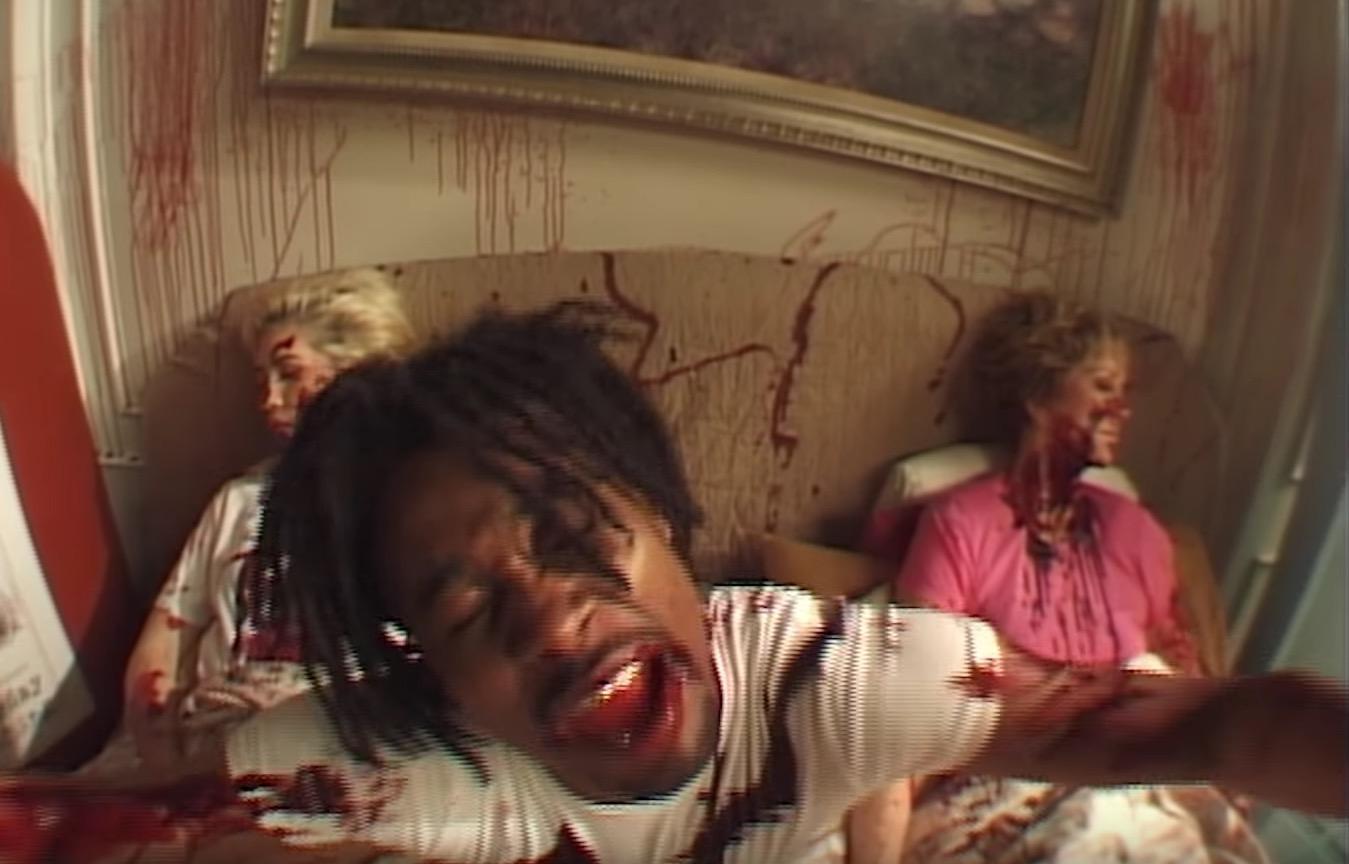
"Own't It Funny" brings to listen what Kinohi Nishikawa describes as hip-hop satire:
Different the high-minded, expressionless-serious music of "socially witting" artists, hip-hop satirists have taken refuge in the comic mode as a means of undoing authenticity's hold on African American civilisation. Their efforts accept led to the development of a growing, if nonetheless inchoate, field of hip-hop satire: a subgenre that advances the funniest, and often well-nigh profound, critique of rap'due south investment in "keeping it existent."15
But here, Chocolate-brown's satire belongs strictly to the video. The lyrics could not be more than dead-serious. They document Brown'southward low and addiction to a cocktail of different prescription drugs including Adderall and Xanax as well as cocaine and alcohol. Against the hip-hop clichés that glorify the drug merchandise, the song describes, "The flow firm of horror/Dead bolted with metal doors." Chocolate-brown attributes his addiction to survivor'south guilt, "Live a fast life/Seen many die slowly/Unhappy when they left/Then I try to seize the moment." Brown'south corybantic energy cannot break him out of this house of horror. The song ends with resignation: "Tin can't quit the drug use/Or the alcohol abuse/Even if I wanted to/Tell you what I'm gonna do/I'ma wash away my bug/With this bottle of Henny/Anxiety got the best of me/So popping them Xannies." The tension between the force of his phonation, the clarion horns, and the despondency and hopelessness of the narrative make "Ain't It Funny" a deeply personal and painful vocal set against the satirical rendering of a sitcom.
Whereas Detroit is now a preferred setting for horror in American cinema, the Detroit suburbs have long been integral for the cultural imaginary of an arcadian America, serving as the setting for sitcoms nigh mostly flush, by and large white families, including Home Improvement, 8 Simple Rules, and Freaks and Geeks. In these shows, the safe settings free upwardly families to learn feel-good life lessons and grow together; danger is just comical, like when Tim Allen repeatedly electrocutes himself with overcharged power tools. The two Metro Detroit sitcoms that featured African American protagonists, Martin and Sister Sister, also capture the racial and economic contradictions of Detroit. In one telling example from Sister Sister, "Mo' Credit, Mo' Bug" (S5 E11), Tia and Tamera get lost in downtown Detroit because the thruway ramp is closed — the state highway is a crucial escape valve for suburbanites — and their motorcar breaks downwards. When a beau attempts to help them, the twins frantically debate if he "wants to murder us" or "probably simply wants to rob us," but ultimately accept his assistance and acquire the lesson that (Blackness) Detroiters are in fact people too. Against Detroit horror films, and revising the Detroit suburbs sitcom, Brown's music videos suggest that the suburbs are where horror actually happens.
Brown'due south clearest joint of "Ain't It Funny"'south title links his depression with the fantasy of achieving the good life and making it to the suburbs: "Octopus in a direct jacket/Savage with bad habits/Bankrupt serving fiends/Got rich became a addict/Own't it funny how it happens/Who would ever would imagine." Though the clearest reference to the suburbs, this verse is edited out of the music video and replaced with a segment of the alive sitcom. In this interlude, "Dad" walks in on Uncle Danny while he is urinating on a vase of flowers and family portraits in the living room. When Dad asks why he's doing this, Uncle Danny explains, "I've been destroyed and if I destroy mayhap I'll experience okay." Dad responds, "None of u.s.a. feel okay," and "the Child" breaks the tension with his archetype "Oh Uncle Danny" line before the his eyes turn into lasers and nosotros return to Uncle Danny's murder fantasy. The very moment in the vocal's lyrics that document Brownish's detail Detroit rags-to-riches story, which implies his departure from the city and into the suburbs, is substituted with an entreatment to the universal: "none of united states of america feel okay." Inside the song, Dark-brown is sensitive to the ways that his depression is part of a broader historical attunement with others, rapping "It's a living nightmare/That most of us might share." But he follows this immediately with the lines "Inherited in our blood/It'due south why we stuck in the mud," which I interpret as referring to the affective experience of Black Americans, and non someone similar Dad. The sentimentality of the white suburban sitcom, which presumes to speak for a universalized "America," is shown to exist not only ineffective in treating Uncle Danny's sickness, but an active agent in exacerbating it.
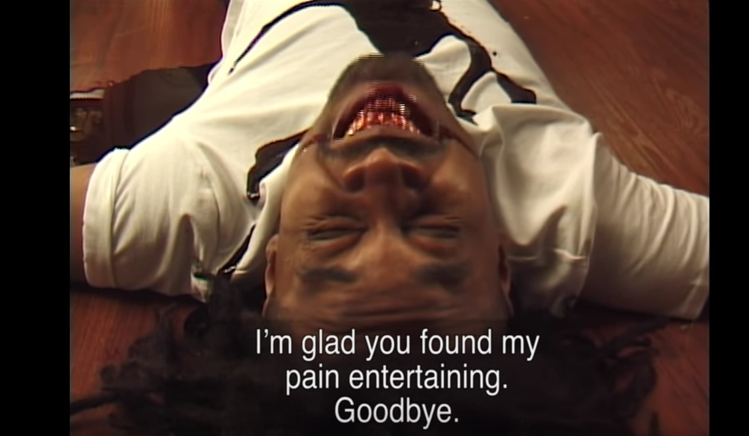
Through its deployment of the suburban sitcom, the music video adds a metafictional layer to the vocal's lyrics that aggressively implicates the (white) audition in Brown's addiction. Silenced by the audio of both the song itself and the laughter of the all-white audience, Uncle Danny'south pleas for help are restricted to subtitles, "I have a serious problem. Please finish laughing." At the conclusion of the video, Uncle Danny re-directs his plea away from the white audition and toward the large mascots of prescription drugs, grin equally he says, "You guys are my only friends. I need you." The mascots continue to stab and impale Uncle Danny, and the Kid joins him in breaking the quaternary wall to condemn the audience, saying, "He's DYING and y'all people are LAUGHING. Yous Cloy me." Over the final refrain of "Ain't it? Own't it funny how it happens? Own't information technology?" Uncle Danny's last words (again subtitled) are "I'm glad you lot found my hurting entertaining. Cheerio."
The video shifts the pregnant of "ain't it funny" from being about Brown becoming an addict later leaving Detroit and moving to the suburbs to existence well-nigh the way (white) audiences' primary engagement with him is equally a spectacle to consume, much the way audiences all too often consume and discuss Detroit. Put together, the song and music video agree in tension the actual, racial materiality of Detroit with the burden of its symbolic significance on the psychic life of individuals who alive or accept lived there. Past admonishing his audience, Brown asks them to do the much more hard work of conducting an honest reckoning of not but what they gain from their mediated relationships with Detroiters, but their complicity in the racism and economic inequality that generate physical and mental health crises. "Ain't Information technology Funny" reconstitutes for contemporary listeners a human relationship and responsibility to Detroit horror, perchance captured best decades ago in an urban dejection vocal used by Detroit's League of Revolutionary Black Workers in 1969-1970, "Enough! America, we don't mind working, only we do listen dying."xvi
References
Source: https://post45.org/2019/04/aint-it-funny-danny-brown-and-detroit-horror/

Post a Comment for "Danny Brown Funny How It Happens"